

Kim Kardashian has appeared on countless magazine covers, but the Kim Kardashian Paper Magazine cover remains one of the most talked-about images of her career. Released in 2014, the shoot quickly became a major topic in entertainment, fashion, and online culture. It was bold, playful, and deliberately designed to attract attention.
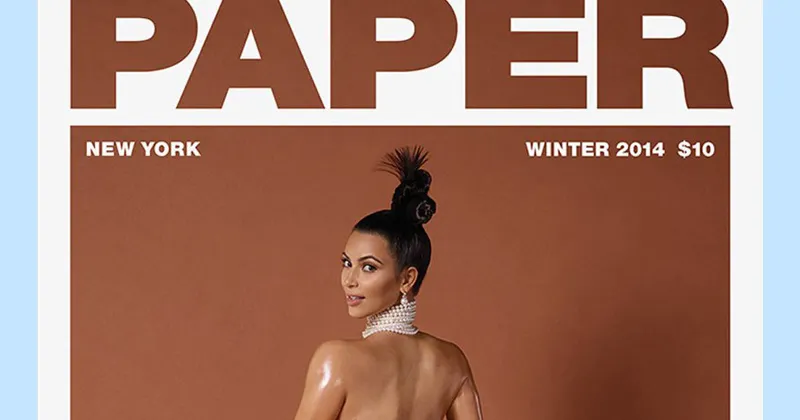
The cover was part of Paper magazine’s winter 2014 issue and featured Kardashian photographed by Jean-Paul Goude. The accompanying concept drew heavily from Goude’s distinctive visual style, while Kardashian brought her own celebrity identity and public image to the project. The result was an image that quickly moved beyond the magazine itself.
What made the cover so memorable was not simply the photograph. It was the way the entire project captured a changing moment in celebrity culture. Social media was becoming increasingly powerful, celebrity images could spread around the world within minutes, and fashion magazines were experimenting with ways to create online conversation. Kardashian’s Paper shoot became a perfect example of how those elements could come together.
The Story Behind the Kim Kardashian Paper Magazine Cover
The famous Paper shoot was created by French photographer and artist Jean-Paul Goude, who was known for highly stylized photography, dramatic compositions, and an interest in performance and spectacle. His work often played with exaggerated poses, proportions, and carefully constructed visual ideas.
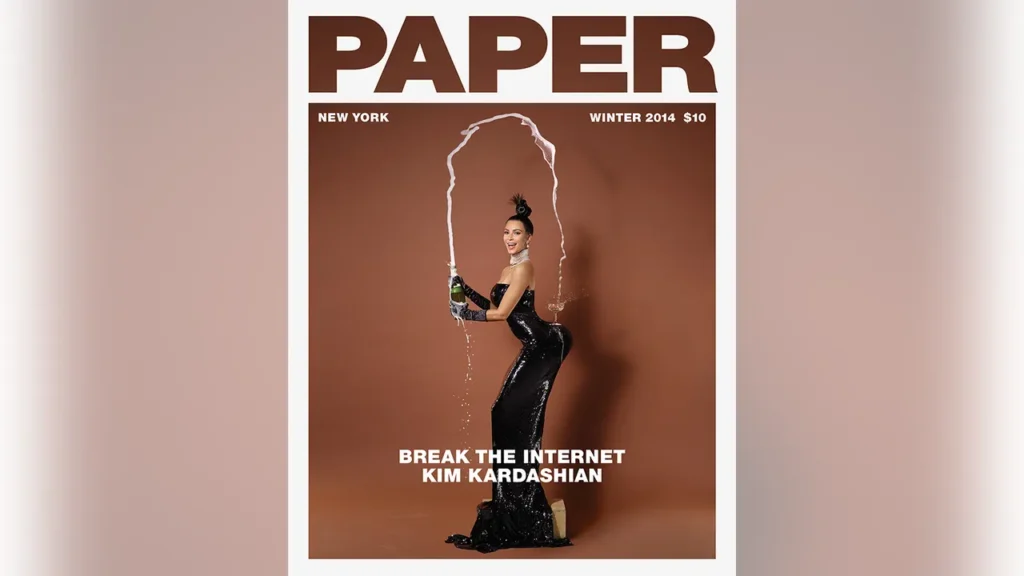
For the Kardashian shoot, Goude used a concept connected to his earlier work. One of the best-known images showed Kardashian balancing a champagne glass on her raised backside while the bottle sprayed champagne into the glass. Another photograph became the cover image, showing her in a black dress with her back toward the camera.
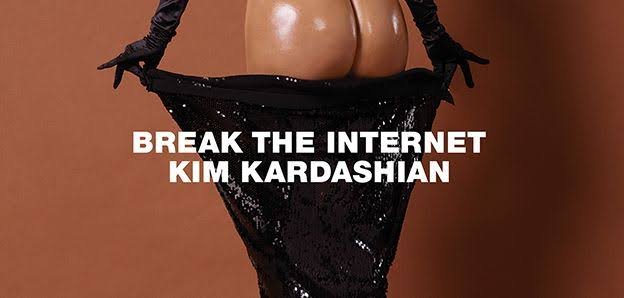
The cover carried the provocative headline “Break the Internet Kim Kardashian,” making the publication’s goal clear. It was not intended to be an ordinary celebrity cover. It was created as an event.
The phrase itself became closely associated with the shoot. Kardashian was already one of the world’s most recognizable reality television personalities, but the Paper project helped reinforce her ability to generate enormous attention with a single image.
The photographs were highly controlled rather than spontaneous. Lighting, styling, posing, composition, and retouching all contributed to the final effect. That level of planning helped make the shoot feel more like a visual campaign than a conventional magazine portrait.
Why the Shoot Received So Much Attention
The timing of the cover played an important role in its success. By 2014, Kardashian had become a major figure in entertainment, fashion, television, and social media. Her personal brand was closely connected to visual culture, and her images were already widely shared online.
The Paper cover took that phenomenon and amplified it.
Within a short period, images from the shoot were being shared, discussed, parodied, criticized, and referenced across the internet. The phrase “break the internet” became part of the conversation surrounding the photographs.
There was also an element of surprise. Magazine covers featuring celebrities were common, but the Paper shoot was unusually provocative and theatrical. It did not attempt to present Kardashian through a traditional glamorous portrait. Instead, it leaned into exaggeration and spectacle.
That decision gave people something to talk about.
Some viewers saw the shoot as clever self-promotion and an example of Kardashian understanding modern media better than almost anyone. Others criticized the images for being overly provocative or questioned the cultural implications of the photography.
Both reactions contributed to its visibility.
In the age of social media, controversy and conversation can be just as valuable as straightforward approval. The Paper cover demonstrated how an image could become a cultural talking point simply by giving audiences something they wanted to discuss.
Jean-Paul Goude’s Artistic Influence
Knowing what the photos were to be used for can help to understand why the pictures were so unusual.
Jean-Paul Goude had been working for years with a combination of photography, advertising, fashion, dance and performance. His style of visualization often included exaggerated gestures and poses. He did not just portray people as they were, he often frames and designs a scene with a purpose.
The Kardashian shoot was a reflection of that.
The champagne photograph, for example, was more than a simple portrait. This was a shot that happened in one frame. It had to be the right pose, a glass, a glass of champagne, and the right time.
Goude also took an earlier photo of his from his career with Kardashian and recreated it, establishing a connection between his past and the new work.
The recreation got talked about in the shoot. It demonstrated the photographs’ relationship with larger visual history.
This is a situation that continues to make the shoot a hot topic for discussions. It can be considered simultaneously as celebrity photography, fashion imagery, advertising art, performance and as internet culture.
Kardashian’s Role in Building the Moment
Kardashian’s was also a pivotal one. By 2014, she had gained insight into the power of publicity, television, fashion, and the social media to build on each other.
She was not just posing in the pages of a magazine. She was involved in an orchestrated cultural moment.
The idea of a Paper shoot did fit into the public persona that Kardashian had built up. She had also developed a reputation for accepting attention, not running from it, and the photos captured that.
She also allowed the photographs to be shared to her huge online readership which helped the project to reach beyond the readership of Paper.
This was especially important as social media was reshaping the dynamic between stars and magazines. During the previous decades, the distribution of celebrity photography was dominated by magazines. By the 2010s, celebrities were able to directly post photos to millions of followers.
Kardashian knew how to do that so much.
Just minutes after release, the magazine cover could be snapped, shared, commented, remixed into memes and used in other media. Each new interaction provided another chance for the initial image to “recycle its way around.Each new interaction provided another chance for the initial image to “recycle its way around”.
The shoot wasn’t just about the photograph, in that respect. It was also a matter of distribution.
The Meaning of “Break the Internet”
The term “break the internet” became one of the most well known aspects of the campaign.
The internet actually didn’t go down because of Kardashian’s photos. The title was intentionally made exaggerated to reflect the amount of online attention the images were anticipated to receive.
That is a over-exaggeration, and it was part of the appeal.
The cover basically has made virality part of its marketing. It recognized how internet culture functioned and made online attention an integral part of the narrative.
This was especially effective, as Kardashian herself was already deeply involved with the social media culture. Her fans weren’t passive magazine readers. They were active participants that could share and discuss her content immediately.
The Paper cover, therefore, was a change in the way celebrity publicity could be done.
An eye-catching photo might be the story itself rather than a press release. Bloggers could provide information about it, Facebook and Twitter fans could comment on it, and other celebrities could mention it.
The more people talked about the photograph, the more likely the photograph seemed to be of more significance.
The Fashion and Photography Legacy
The Kim Kardashian Paper Magazine shoot also had an impact on conversations about celebrity fashion photography.
Often magazine covers have to be art and commerce. The Paper project started to turn that for an even more theatrical shift.
Kardashian’s style was definitely glamorous, and the poses were exaggerated and humorous. The mix of these helped differentiate the shots from a typical fashion spread.
The shoot also demonstrated that the physical body and the public image of a celebrity could become the mainstream of a magazine’s visual brand.
Beauty standards, body image, race, sexuality, celebrity culture and the history of fashion photography were discussed. Some discussions were about Kardashian, others were about Goude’s artistic techniques, and others discussed the sources which inspired the photos.
The cover thus grew to be bigger than one magazine issue.
It has been cited as a case study in a number of instances in which they have been talking about the connection between celebrity and photography, publicity and digital media.
Why People Still Remember the Cover
The popularity of many celebrity magazine covers rises when they are published and then fall out of the conversation. The cover on the Paper was different.
One of its reasons for success is its simplicity. The visual concept is instantly understood. The image has likely appeared online even for those who didn’t buy the magazine.
Secondly, there’s the timing.
The shoot coincided with a time when social media was being embraced as a key component in celebrity marketing. Instagram, Twitter, blogs, entertainment venues and online publications set the stage for a single picture to spread like wildfire.
It was also an environment in which Kardashian could be uniquely positioned to take advantage of.
As she became a celebrity, everything she did was bound to get noticed, but the weirdness of the Paper photographs made the news and their viewers an easy target for discussion.
The cover also became a benchmark for other celebrity campaigns later on. The stories of public figures and brands that could be easily shared, not only in traditional media, but also online also started to take shape.The stories of public figures and brands that could be easily shared, not only in traditional media, but also online also began to take shape.
In that case, the Paper shoot was a forerunner of the current fashion of celebrity marketing.
The Broader Cultural Conversation
It’s not always that everyone found it beautiful and/or tasteful, that’s not the lasting significance of the shoot. What made it important was the fact that it sparked conversation about the image of a celebrity’s purpose.
Was the shoot on-trend?
Was it art?
Was it publicity?
Was it satire?
Did he do it to get attention?
The response could be reasonably anything more than one of these.
There is a lot of fusion and overlap between entertainment, advertising, personal branding, and visual art in the modern celebrity culture. They became more apparent on the Paper cover.
It also proved to be a very powerful combination of a familiar name and a trusted name in the creative industry. Goude provided his art words, and Kardashian was responsible for his giant fan base and well cultivated public persona.
All those things combined made for something that couldn’t be ignored.
The controversy over the images also is a testament to a key aspect of pop culture: sometimes a controversial or even strange image has more cultural impact than one that is universally adored.
Surprises are what people remember.
This was certainly achieved by the Paper cover.
Final Thought
The Kim Kardashian Paper Magazine cover remains an important example of how celebrity, fashion photography, and internet culture can come together to create a major media moment. Its success was not based on the photograph alone. Timing, artistic direction, Kardashian’s celebrity status, social media, and the deliberately provocative concept all played a role.
Years later, the shoot is still remembered because it represented more than a magazine cover. It captured a period when celebrity publicity was becoming increasingly digital, visual, and interactive.
Whether viewed as fashion photography, performance, publicity, or pop culture spectacle, the Paper shoot demonstrated one simple idea: a carefully constructed image can become much bigger than the publication that first printed it.
Visit this site and more information: Vogue Magazine
FAQs
Who photographed Kim Kardashian for Paper magazine?
The Paper magazine shoot was photographed by Jean-Paul Goude, a French photographer and artist known for highly stylized and theatrical visual work.
When did Kim Kardashian appear on the Paper magazine cover?
Kim Kardashian appeared on the cover of Paper magazine’s winter 2014 issue. The cover became widely discussed after its release because of its provocative concept and the “Break the Internet” headline.
What was the “Break the Internet” concept?
“Break the Internet” was the headline and central publicity concept associated with the Paper shoot. It referred humorously to the expectation that the photographs would generate an enormous amount of online attention.
Why was the Paper cover so controversial?
The cover used provocative poses and imagery that differed from conventional celebrity magazine photography. It generated discussions about celebrity culture, body image, sexuality, fashion, photography, and publicity.
What made the Paper shoot different from a typical magazine cover?
Instead of presenting Kardashian through a conventional portrait, the shoot used theatrical poses, visual references, and carefully constructed compositions. It was designed to be visually striking and highly shareable.
Is the Paper shoot still influential?
The shoot remains a frequently referenced example of celebrity-driven internet culture. It demonstrated how a magazine image could become a major online event and helped illustrate the growing relationship between social media and celebrity publicity.
